Each year, Bank of America hosts the Affordable Housing Challenge. In a climate of rising housing costs, the competition invites students to engage directly with the complexities of affordable housing development.
Over a 12-week sprint, teams take on the role of affordable housing developers—identifying a project site, crafting a design concept, defining community partners, estimating total development costs, assembling a funding strategy, and building a full pro forma. The process requires both creativity and technical rigor, pushing students to translate ideas into projects that are financially and operationally feasible.
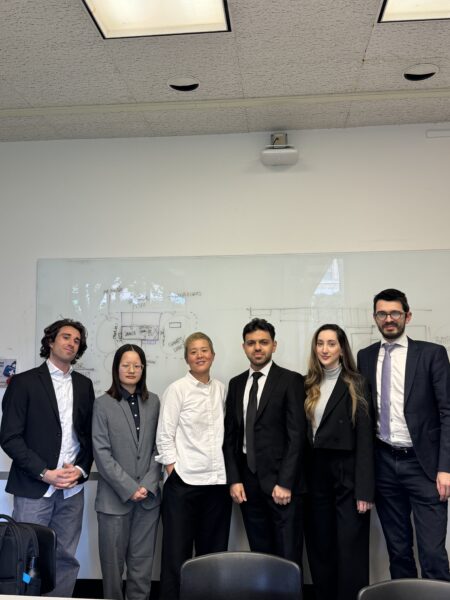
This year marked the largest competition in the program’s 35 year history, with a record 16 teams representing 10+ universities from across the U.S. The University of Washington, was represented by two interdisciplinary teams from across the College of Built Environments. The undergraduate team included Laura Haksworth (Community Environment and Planning), Teera Bangsaruntipya (Real Estate), Hailey Hellenkamp (International Studies and Political Science), Emily Van (Architectural Design), and Tsung-Pei Yu (Real Estate). The graduate team included Vincent Bub (MSRE), Kai Chang (MSRE), Vy Le (MSRE), Aysegul Pilavci (MSRE), Elgun Tarverdiyev (MSRE), Shuhan Yi (MSRE), and Nicholas Miranda (MArch).
Advancing to the final round, the UW grad team competed against UC Berkeley, Cal Poly, and cross-institutional teams from UNC Chapel Hill and NC State, and the Women’s Affordable Housing Network and received an honorable mention. Projects were evaluated across four criteria: project finance, design concept, community impact and support, and an overall “X factor,” with jurors representing a broad cross-section of the affordable housing field.
Team member Kai Chang reflects, “The experience was truly invaluable. The growth we experienced over the course of the 3 months was immense. Our level of comprehension dramatically increased. By the end, we were able to navigate an in-depth pro forma, funding policies, tax credits, and building codes with a much deeper level of understanding.”
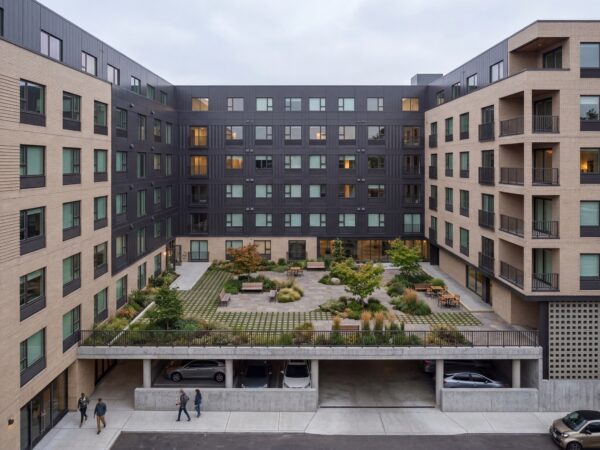
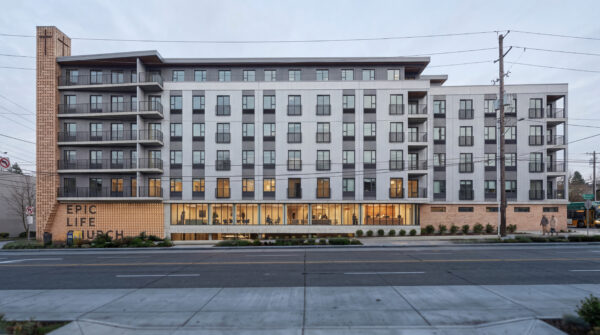
The team’s proposal leveraged unique Seattle policies, including the Religious Organization-Owned Property Ordinance, to redevelop church-owned land. The project envisions 138 units, across one-, two-, and three-bedroom layout, with a focus on family housing and an average affordability target of 55% AMI.
Chang adds, “We’re proud to have been named a finalist. Given the rigor and reach of the competition, as well as the complexities of affordable housing development, I hope we’ve demonstrated the strength of the UW program.”
The challenge aims to empower the next generation of affordable housing leaders. Congratulations to both teams, and special thanks to instructors Arthur Acolin and Rico Quirindongo and partners from the industry and community including Jeff Bernard, Beth Boram, Eden Cano, Keith Carpenter, Al Levine, Lauren Mathisen, and Michele Wang for their guidance along the way.